
Construction And Pharmacological Evaluation Of A New Parkinson's Disease Mouse Model
March 03, 2026


Construction And Pharmacological Evaluation Of A New Parkinson's Disease Mouse Model
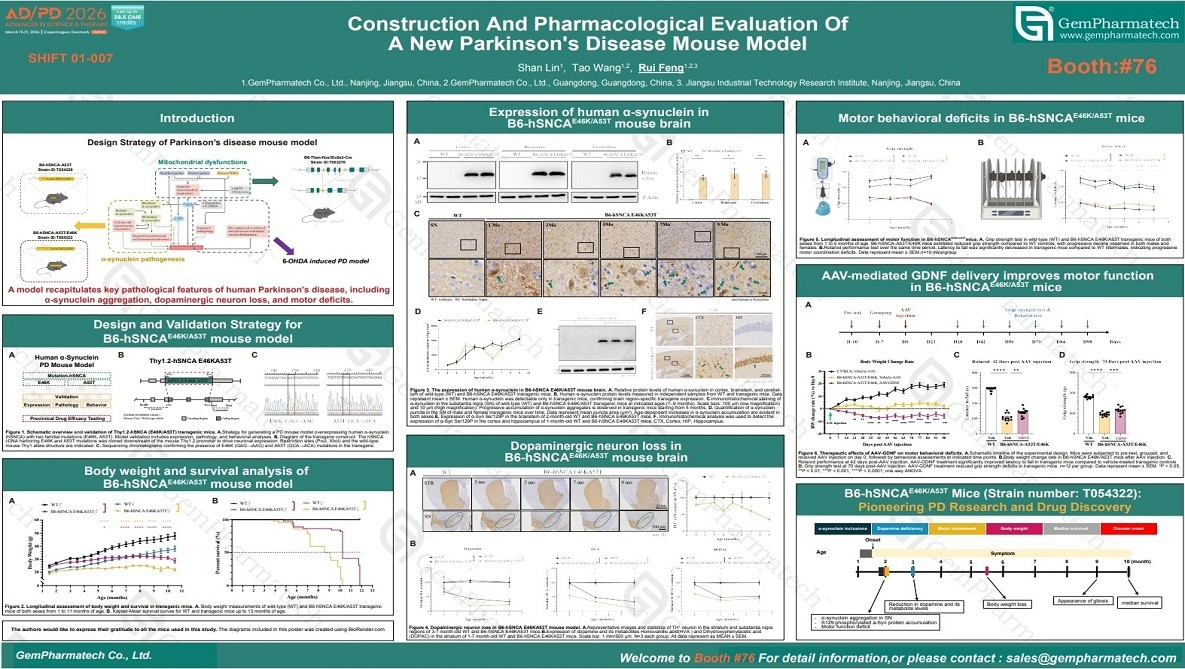
Parkinson’s disease (PD) models typically capture only part of the disease spectrum: toxin-induced models produce dopaminergic neuron loss but lack α-synuclein pathology, while many transgenic models show aggregation without robust neurodegeneration or behavioral deficits. To address this limitation, we developed a humanized α-synuclein transgenic mouse expressing the familial PD mutations E46K and A53T on the C57BL/6J background under the neuron-specific PrP promoter.
This model demonstrates progressive α-synuclein aggregation in the substantia nigra from 1 month of age, accompanied by dopaminergic neuron loss, reduced dopamine levels, and reproducible motor deficits emerging at 2–3 months.
By integrating α-synuclein pathology, nigrostriatal degeneration, and motor impairment, this model provides a robust and translationally relevant platform for Parkinson’s disease research and therapeutic evaluation.
Download
This model demonstrates progressive α-synuclein aggregation in the substantia nigra from 1 month of age, accompanied by dopaminergic neuron loss, reduced dopamine levels, and reproducible motor deficits emerging at 2–3 months.
By integrating α-synuclein pathology, nigrostriatal degeneration, and motor impairment, this model provides a robust and translationally relevant platform for Parkinson’s disease research and therapeutic evaluation.